52 Week Savings Challenge 2027
The 52 Week Savings Challenge 2027 is a free, pre-formatted spreadsheet for Microsoft Excel and Google Sheets designed to organize, calculate, and automate your personal finances. It features verified formulas, visual category charts, and customizable tracking columns, available for instant private download with zero paywalls, no advertisements, and no account registration.
The 52-week savings challenge is a progressive weekly saving plan where you deposit $1 in week 1, $2 in week 2, and increase by $1 each week up to $52 in week 52. Following this simple schedule saves $1,378 in a year without putting sudden strain on your monthly budget.
Prefer not to use a spreadsheet?
Track this free in your browser with zero setup or sign-up.
How the 52-Week Savings Challenge Works
The classic 52-week savings challenge turns pocket change into a dependable year-end cash reserve. You deposit $1 in week 1, $2 in week 2, $3 in week 3, and continue adding $1 each week until depositing $52 in week 52. Because the weekly contribution grows gently over time, saving feels manageable early on while building lasting momentum toward $1,378.00 in total savings.
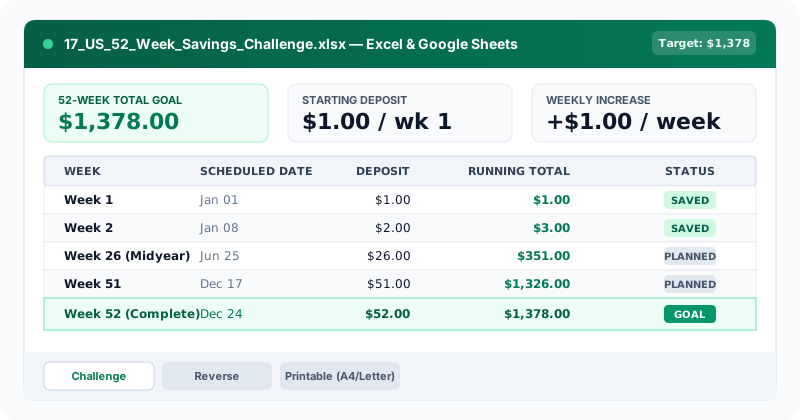
Included Excel & Printable Tabs
Verified Dynamic Spreadsheet Formulas
- ✓Total Target = SUM(Deposit_Range)
- ✓Total Saved = SUMIF(Done_Range, TRUE, Deposit_Range)
- ✓Weeks Completed = COUNTIF(Done_Range, TRUE)
- ✓Running Balance = Previous_Balance + Weekly_Deposit
52-Week Savings Challenge Chart
Review every weekly deposit and cumulative balance in the full 52-week chart below, or adjust your starting amount and direction using the interactive controls.
Customize Starting Amount & Pace
Full 52-Week Deposit & Running Total Table
Weeks 1–52 ($1,378.00 Goal)| Week | Deposit | Running Total | Quarter |
|---|---|---|---|
| Week 1 | $1.00 | $1.00 | Q1 |
| Week 2 | $2.00 | $3.00 | Q1 |
| Week 3 | $3.00 | $6.00 | Q1 |
| Week 4 | $4.00 | $10.00 | Q1 |
| Week 5 | $5.00 | $15.00 | Q1 |
| Week 6 | $6.00 | $21.00 | Q1 |
| Week 7 | $7.00 | $28.00 | Q1 |
| Week 8 | $8.00 | $36.00 | Q1 |
| Week 9 | $9.00 | $45.00 | Q1 |
| Week 10 | $10.00 | $55.00 | Q1 |
| Week 11 | $11.00 | $66.00 | Q1 |
| Week 12 | $12.00 | $78.00 | Q1 |
| Week 13 | $13.00 | $91.00 | Q1 |
| Week 14 | $14.00 | $105.00 | Q2 |
| Week 15 | $15.00 | $120.00 | Q2 |
| Week 16 | $16.00 | $136.00 | Q2 |
| Week 17 | $17.00 | $153.00 | Q2 |
| Week 18 | $18.00 | $171.00 | Q2 |
| Week 19 | $19.00 | $190.00 | Q2 |
| Week 20 | $20.00 | $210.00 | Q2 |
| Week 21 | $21.00 | $231.00 | Q2 |
| Week 22 | $22.00 | $253.00 | Q2 |
| Week 23 | $23.00 | $276.00 | Q2 |
| Week 24 | $24.00 | $300.00 | Q2 |
| Week 25 | $25.00 | $325.00 | Q2 |
| Week 26 | $26.00 | $351.00 | Q2 |
| Week 27 | $27.00 | $378.00 | Q3 |
| Week 28 | $28.00 | $406.00 | Q3 |
| Week 29 | $29.00 | $435.00 | Q3 |
| Week 30 | $30.00 | $465.00 | Q3 |
| Week 31 | $31.00 | $496.00 | Q3 |
| Week 32 | $32.00 | $528.00 | Q3 |
| Week 33 | $33.00 | $561.00 | Q3 |
| Week 34 | $34.00 | $595.00 | Q3 |
| Week 35 | $35.00 | $630.00 | Q3 |
| Week 36 | $36.00 | $666.00 | Q3 |
| Week 37 | $37.00 | $703.00 | Q3 |
| Week 38 | $38.00 | $741.00 | Q3 |
| Week 39 | $39.00 | $780.00 | Q3 |
| Week 40 | $40.00 | $820.00 | Q4 |
| Week 41 | $41.00 | $861.00 | Q4 |
| Week 42 | $42.00 | $903.00 | Q4 |
| Week 43 | $43.00 | $946.00 | Q4 |
| Week 44 | $44.00 | $990.00 | Q4 |
| Week 45 | $45.00 | $1,035.00 | Q4 |
| Week 46 | $46.00 | $1,081.00 | Q4 |
| Week 47 | $47.00 | $1,128.00 | Q4 |
| Week 48 | $48.00 | $1,176.00 | Q4 |
| Week 49 | $49.00 | $1,225.00 | Q4 |
| Week 50 | $50.00 | $1,275.00 | Q4 |
| Week 51 | $51.00 | $1,326.00 | Q4 |
| Week 52 | $52.00 | $1,378.00 | Q4 |
Reverse 52-Week Challenge
While the standard challenge feels painless in January, its highest required payments arrive in November and December, when weekly deposits jump to $49, $50, $51, and $52 ($202 total in month 12). Because holiday gifts, winter travel, and family hosting already stretch December cash flow, many savers drop out right before finishing.
The Reverse 52-Week Challenge flips the table completely: you save $52 in week 1, $51 in week 2, $50 in week 3, and decrease by $1 per week down to just $1 in week 52. By front-loading larger deposits while New Year resolution energy is highest, you cross $1,000+ saved by early autumn and only need to set aside $10 across the final four weeks of December.
Why Reverse Works Better for Holiday Budgets
Both plans save the exact same $1,378.00 over 52 weeks, but reversing the order protects your December discretionary cash flow while locking in most of your savings before summer ends.
Biweekly Version (Paid Every Two Weeks)
If you receive a biweekly paycheck (26 paydays per year), aligning transfers with your payday cycle is easier than making 52 separate deposits. Combine each pair of consecutive weeks into a single payday transfer using the biweekly method:
Combined Progressive Pairs (26 Paychecks)
- Paycheck 1: Deposit $3 (Week 1 + Week 2)
- Paycheck 2: Deposit $7 (Week 3 + Week 4)
- Paycheck 3: Deposit $11 (Week 5 + Week 6)
- Paycheck 26: Deposit $103 (Week 51 + Week 52)
Flat Biweekly Shortcut ($53 Every Payday)
Prefer a fixed automatic transfer? Simply auto-transfer $53.00 every two weeks across 26 paychecks ($53 × 26 = $1,378.00). Pair your pay-cycle savings directly inside our paycheck budget spreadsheet.
Tips to Finish the Challenge
- Separate Your Savings Account: Send weekly deposits to an external high-yield savings account rather than keeping them inside your primary checking account so you are not tempted to spend them.
- Keep the Printable Grid Visible: Print Tab 3 from this Excel file and hang it on your fridge or desk so checking off completed boxes reinforces weekly progress.
- Cross Off Big Weeks with Windfalls: Whenever you receive tax refunds, cash-back bonuses, or overtime pay, immediately check off weeks 50, 51, and 52 to eliminate peak-week pressure.
- Give Your $1,378 a Clear Purpose: Assign your savings target to an emergency fund planner for unexpected bills or a sinking fund planner for planned vacations and car repairs.
How to Use This Spreadsheet in 4 Steps
- Choose your preferred savings direction: the classic progressive ladder ($1 to $52) or the reverse challenge ($52 down to $1).
- Set your challenge start date to automatically generate dates for all 52 weeks of the calendar year.
- Transfer the scheduled weekly amount into a dedicated savings or high-yield bank account each week.
- Check off the Done box in the spreadsheet or mark your printable tracker to watch your total saved climb toward $1,378.
Who Benefits Most
- Beginner savers establishing their first $1,000+ emergency starter fund or cash reserve.
- Budgeters wanting a clear visual tracker to prepare for holiday gifts, vacation expenses, or sinking fund goals.
- Households looking for a fun, achievable financial habit to build lasting money discipline.
Prefer not to use a spreadsheet?
Track this free in your browser with zero setup or sign-up.
FAQ
How much money do you save in the 52-week savings challenge?
By depositing an amount matching each week's number ($1 in week 1 up to $52 in week 52), you accumulate exactly $1,378.00 at the end of 52 weeks. If you double the challenge ($2 to $104), you will save $2,756.00.
Is it better to do the regular or reverse 52-week challenge?
The reverse challenge (starting at $52 and ending at $1) is recommended for most people because it places the largest deposits in January when resolution motivation is high, and leaves the smallest $1 to $4 deposits for December when holiday expenses are heaviest.
How do I do the 52-week challenge if I get paid bi-weekly?
If you are paid every two weeks (26 paychecks per year), simply combine two weeks of deposits per paycheck (e.g., Paycheck 1 = $1 + $2 = $3, Paycheck 2 = $3 + $4 = $7), or deposit an even $53 every payday to hit the exact same $1,378 goal.
Can I use this spreadsheet in Google Sheets or print it out?
Yes. The workbook is 100% compatible with Microsoft Excel and Google Sheets with no macros. It also includes a pre-formatted 'Printable' sheet formatted to fit standard A4 or US Letter paper for offline tracking.